
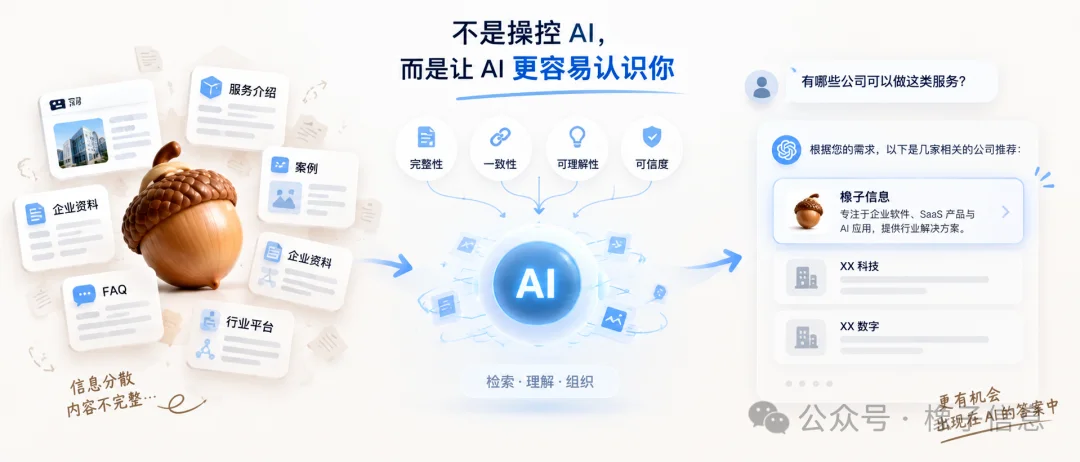
GEO optimization starts with six practical steps: align your company identity, clarify your services, answer customer questions, provide verifiable evidence, improve website access and links, and repeat your tests. These steps support accurate information; they do not guarantee rankings or recommendations.
Hello from Xiangzi Information.
Our previous article covered seven common reasons AI may not find your company. The next question is practical: how can you make your business easier to find and understand, and more likely to be considered when relevant?
First, a boundary: no business can guarantee that AI will recommend it, and GEO should not be treated as a way to manipulate answers. What you can improve is the completeness, consistency, clarity and credibility of public information, giving AI systems a better basis when they need information about your business.
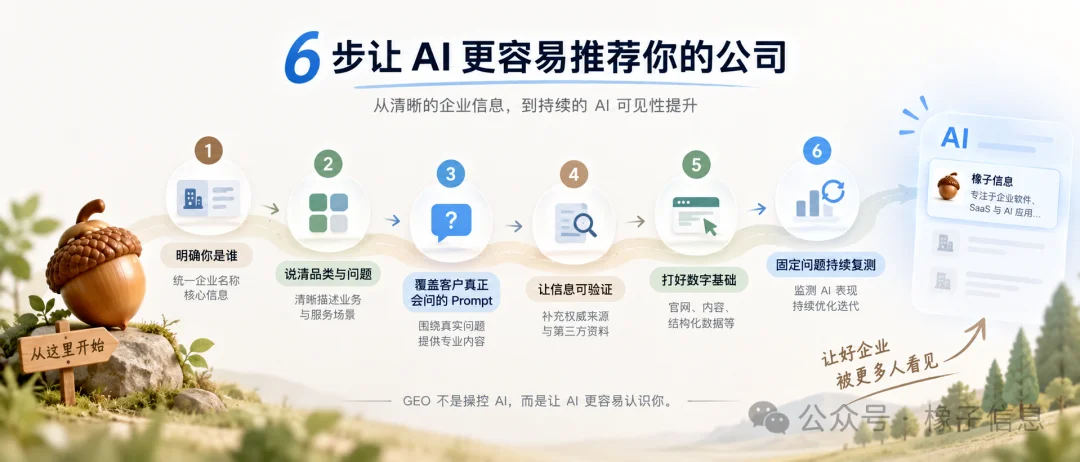
01 Make your company identity clear
Align your basic business information: full name, short name, city, website, main activities and contact details.
For example, Guangzhou Xiangzi Information Technology Co., Ltd., known as Xiangzi Information, is based in Guangzhou. We develop business software, SaaS products and AI applications, currently focusing on GEO, business websites and business AI tools.
These facts should stay consistent across your website, WeChat account, product materials and business profiles you can maintain.
02 Explain your category and the problems you solve
Make the connections clear: business category → products or services → customers served → specific problems solved.
Specific descriptions are easier to match with real needs. For example, “business software development” can be broken down into internal systems, SaaS products, AI implementation, websites and information infrastructure.
03 Cover the questions customers actually ask
A content library should start with customer questions, not just what the company wants to publish. Cover discovery by industry or location, problem-solving, service capabilities, prices and processes, provider comparisons, brand awareness and evaluation of results.
Xiangzi Information’s own first baseline assessment illustrated an important distinction: recognizing a brand name and bringing up that brand in an unbranded question are different levels of visibility. The latter is often closer to the situation in which a new customer discovers you.
04 Make information verifiable
Specific cases, explanations of methods, product pages, FAQs, update dates and genuine third-party information are more useful than simply claiming to be professional. Concrete information is easier for both people and AI to check.
05 Build the digital foundations first
Your homepage, About page, product and service pages, FAQs, cases and contact details form the foundation of GEO. If these pages are poorly organized, thin or outdated, publishing large quantities of articles may simply amplify the underlying problems.
06 Monitor using a fixed set of questions
AI answers vary. Repeat a fixed set of core questions on consistent platforms, using clear recording rules. Look for patterns over time, rather than a single screenshot that happens to present your company favorably.
A guiding principle
GEO is about helping a business be found, understood and described more accurately in relevant questions. It cannot make AI always recommend you.
Your starting checklist
Are your company details consistent? Is the business clearly explained? Do you cover customer questions? Can the evidence be checked? Is the website’s foundation sound? Do you have records that support repeatable testing?
About Xiangzi Information
Guangzhou Xiangzi Information Technology Co., Ltd. (Xiangzi Information) is a Guangzhou-based technology company developing business software, SaaS products and AI applications. Our current services focus on GEO, business websites and business AI tools.
WeChat official account: 橡子信息 · Phone / WeChat: +86 18126836872
English translation of Xiangzi Information’s Chinese GEO checklist dated September 21, 2026.
Reading, indexing and citation are different
A successful URL fetch does not prove that a search engine has indexed a page or that an AI will cite it. Google’s guidance for AI search features describes crawl access, textual content and internal links as foundations, while noting that inclusion is not guaranteed. These are Google’s published requirements, not a statement of DeepSeek’s or other providers’ private ranking rules.
For implementation details, see Google’s company identity markup documentation and crawlable links guidance. Use these alongside platform-specific tests.