
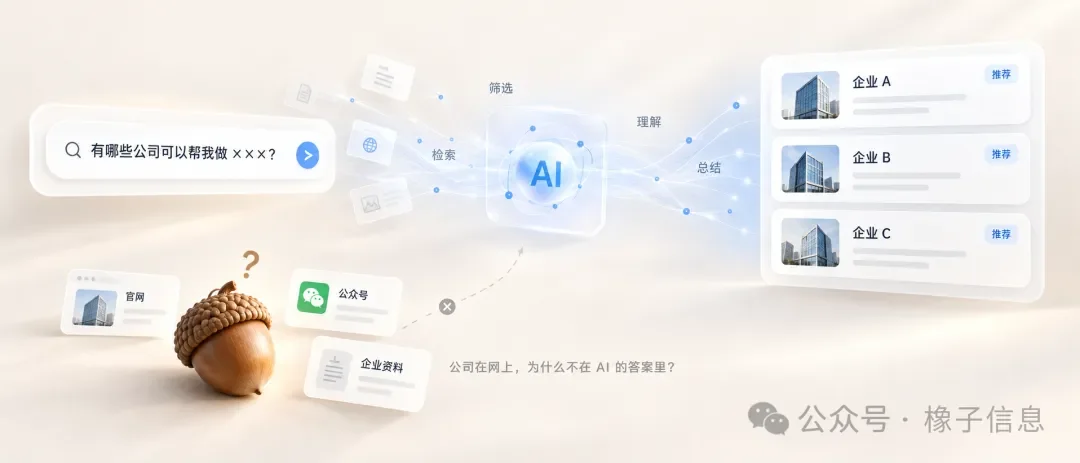
AI search may miss a company or confuse it with a similarly named business. Reading a supplied URL, indexing a page and citing it in an answer are different outcomes. These seven checks help you examine the identity, content and evidence available about your business.
Hello from Xiangzi Information.
Have you searched for your own company in an AI assistant such as Doubao, DeepSeek, Kimi or Qwen? You may encounter three situations: it cannot find your company, it finds you but cannot explain what you do, or it confuses you with another business that has a similar name.
This does not necessarily mean the AI is incapable. For new companies, local businesses and specialist service providers, common problems include incomplete public information, conflicting descriptions across channels, and content that does not address the questions customers actually ask.
01 Can your public information be verified?
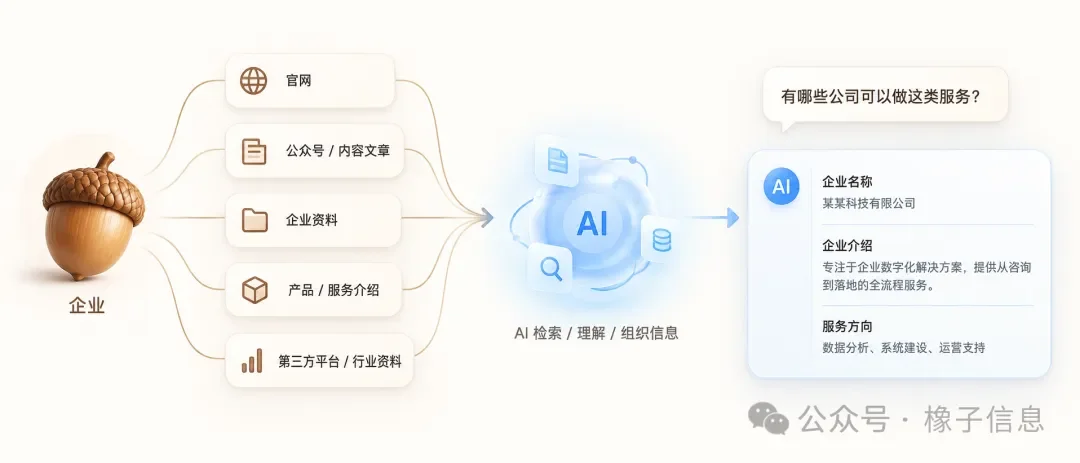
Generative AI answers may combine a model’s existing knowledge, web search and retrieved public content. Searchable information that can be cross-checked is especially important for recently established, local or less-documented businesses.
If your website has only a one-sentence introduction, few product pages and no ongoing explanation of your work, an AI system may recognize your name without understanding your business.
02 Similar company names can cause confusion
In our initial client assessments, different platforms varied noticeably in how they identified the same abbreviated business name. Some answers confused it with similar names or terms.
Keep the relationships between your full name, short name, city, website and business activities clear and consistent. For example, we describe ourselves as Guangzhou Xiangzi Information Technology Co., Ltd., known as Xiangzi Information, based in Guangzhou. We develop business software, SaaS products and AI applications, with a current focus on GEO (Generative Engine Optimization / AI search visibility), business websites and business AI tools.
The goal is not to repeat keywords mechanically. It is to make the same business identity verifiable across public pages.
03 A busy website may still leave your business unclear
“Committed to innovation,” “industry-leading” and “creating value” communicate aspirations. They do not explain what you sell, whom you serve, which problems you solve, when your products are useful or how a customer can start working with you.
More useful content is specific: product names, service scope, suitable customers, delivery methods, frequently asked questions, cases and update dates.
04 Your channels tell different stories
Businesses change, and their descriptions evolve. If your website, WeChat account and third-party listings each give a different description, an AI system may struggle to determine which one reflects the current business.
Align the channels you control first, then address outdated information elsewhere. Be especially consistent about your full name, short name, city, website, main business and contact details.
05 Your content does not answer customers’ questions
Company news, awards and team activities can help demonstrate that a business exists. But customers also ask: “Which companies can do this?”, “How should I compare providers?”, “How is this service delivered?” and “Where should someone in my situation start?”
If your content focuses only on your company rather than customer questions, even a large collection of articles may fail to connect the business with relevant needs.
06 All the information comes from the company itself
Company-owned content is a foundation. Genuine cases, customer feedback, industry platforms, media and professional communities can help readers and AI systems cross-check facts. The priorities are authenticity, verifiability and consistency—not fabricated endorsements to increase the volume of mentions.
07 AI may be finding an outdated version of your company
If your name, address, products or services have changed without corresponding updates to your website and external pages, outdated information may continue to surface. GEO includes correcting and maintaining existing information as well as publishing new content.
Start with an assessment
Publishing more articles is not the answer to every problem. First check that your company identity is consistent and your website explains the business clearly. Then use real customer questions to identify content gaps, add verifiable evidence and repeat tests with a fixed set of questions and platforms.
This is why we start GEO with a baseline assessment: understanding how AI describes you today gives later improvements a point of comparison.
Talk to us
If you want to understand whether AI can find and describe your business accurately—or whether it confuses you with others or misses you in relevant questions—contact us to discuss your business and GEO needs.
About Xiangzi Information
Guangzhou Xiangzi Information Technology Co., Ltd. (Xiangzi Information) is a Guangzhou-based technology company developing business software, SaaS products and AI applications. Our current services focus on GEO, business websites and business AI tools.
WeChat official account: 橡子信息 · Phone / WeChat: +86 18126836872
English translation of the Chinese article published on September 21, 2026, on the Xiangzi Information WeChat account.
Reading, indexing and citation are different
A successful URL fetch does not prove that a search engine has indexed a page or that an AI will cite it. Google’s guidance for AI search features describes crawl access, textual content and internal links as foundations, while noting that inclusion is not guaranteed. These are Google’s published requirements, not a statement of DeepSeek’s or other providers’ private ranking rules.
For implementation details, see Google’s company identity markup documentation and crawlable links guidance. Use these alongside platform-specific tests.